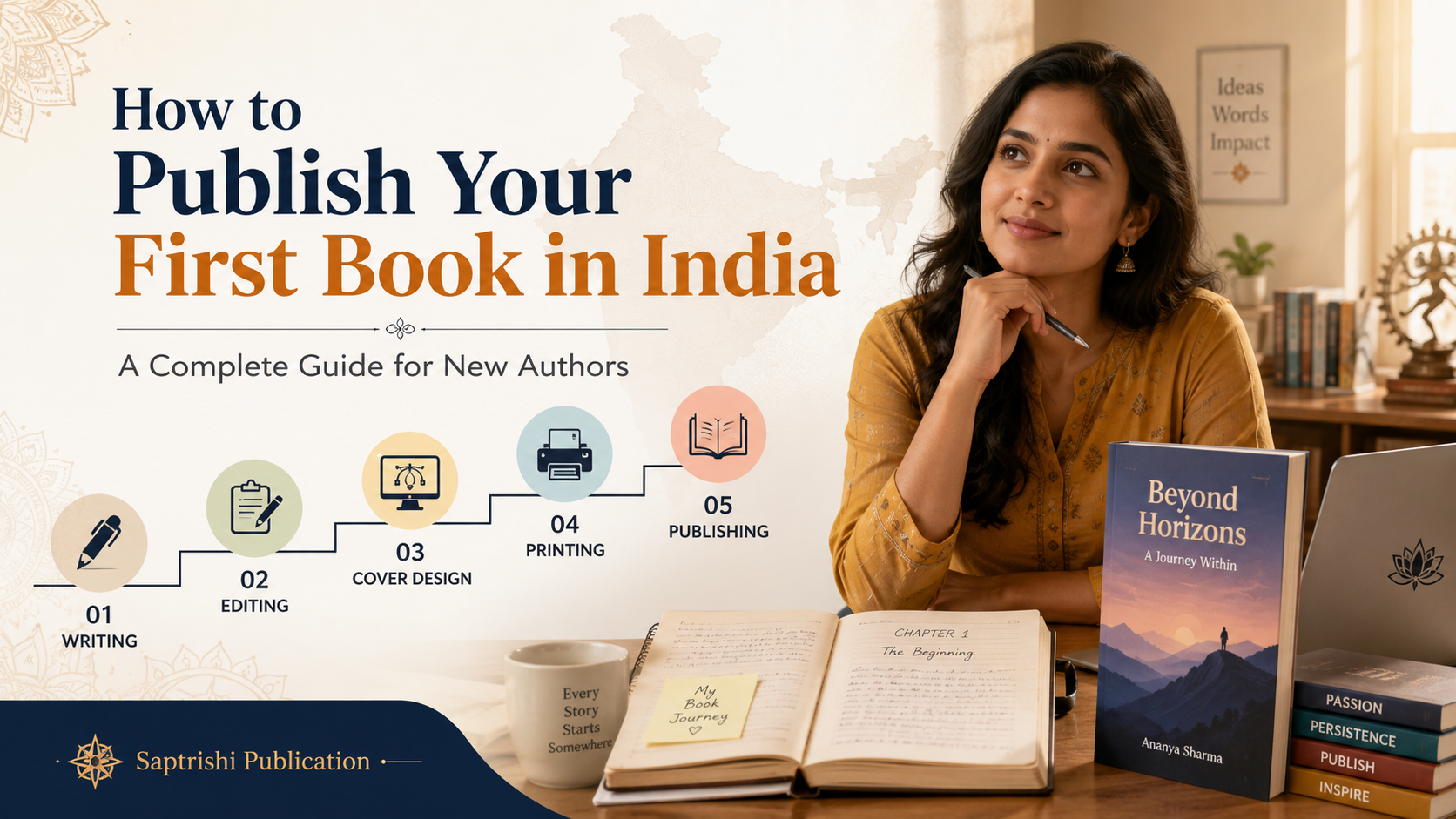
Writing a book is a dream for many people, but publishing that book often feels confusing. Many first-time authors have questions like: Where should I start? Do I need an ISBN? How much does book printing cost? Should I choose self-publishing or a publisher? How can I sell my book online?
The good news is that publishing a book in India has become easier than ever. Today, authors can publish poetry books, novels, biographies, academic books, children’s books, religious books, Punjabi books, Hindi books, English books, and many other types of manuscripts with professional support.
In this guide, we will explain the complete process of publishing your first book in India step by step.
1. Complete Your Manuscript First
The first step is to complete your manuscript. A manuscript is the written content of your book before it is designed and printed.
Before sending your manuscript to a publisher, check these basic points:
- Is the book complete from beginning to end?
- Are all chapters properly arranged?
- Is the title finalized?
- Is the author name correct?
- Are poems, stories, references, or quotations properly checked?
- Is the language clear and readable?
Many new authors send incomplete manuscripts and then keep making changes again and again. This can delay the publishing process. So, first prepare a clean and final version of your manuscript in MS Word or Unicode text format.
2. Choose the Right Book Category
Before publishing, you should know the category of your book. This helps in editing, design, pricing, marketing, and online listing.
Common book categories include:
- Poetry
- Novel
- Short stories
- Biography
- Autobiography
- Religious and spiritual books
- Children’s books
- Academic books
- Competitive exam books
- Punjabi literature
- Hindi literature
- English literature
- Motivational books
Choosing the right category also helps readers understand what your book is about.
3. Get Professional Editing and Proofreading
Editing is one of the most important steps in book publishing. Even a good manuscript may contain spelling mistakes, grammar errors, punctuation issues, or sentence problems.
Proofreading helps remove small mistakes, while editing improves the flow, clarity, and quality of the writing.
For example, in Punjabi or Hindi books, font and Unicode issues are also very important. If the text is not properly converted or checked, the book may show broken letters or incorrect characters after printing or online upload.
A professionally edited book creates a better impression on readers and increases the author’s credibility.
4. Format the Book Interior
After editing, the book needs proper formatting. Interior formatting means arranging the inside pages of the book in a professional way.
This includes:
- Page size
- Margins
- Font selection
- Chapter headings
- Page numbers
- Table of contents
- Line spacing
- Paragraph style
- Title page
- Copyright page
- Author page
A well-formatted book looks clean and easy to read. Poor formatting can make even good content look unprofessional.
For printed books, formatting should be done according to the final book size, such as 5×8 inches, 6×9 inches, A5, or any custom size.
5. Design a Professional Book Cover
The book cover is the first thing a reader notices. A strong cover can increase interest in your book, while a weak cover can reduce its appeal.
A professional book cover should include:
- Book title
- Author name
- Subtitle, if needed
- Suitable image or design
- Back cover description
- Barcode space, if required
- Publisher logo, if applicable
The cover should match the theme of the book. For example, a poetry book may need an emotional and artistic cover, while a competitive exam book needs a clean and informative cover.
Never treat book cover design as a small step. It plays a major role in book sales and reader attention.
6. Apply for ISBN
ISBN stands for International Standard Book Number. It is a unique 13-digit number used to identify a book. In India, ISBN is issued through the official ISBN agency.
An ISBN is useful for:
- Book identification
- Library records
- Bookstore listing
- Online selling
- Publisher records
- Distribution purpose
If you are publishing through a professional publisher, they may guide you regarding ISBN. If you are self-publishing, you can also apply for ISBN as per the official process.
For every edition and format, ISBN requirements may differ. For example, paperback, hardcover, and ebook versions may need separate ISBNs.
7. Decide: Self-Publishing or Publishing with a Publisher
In India, authors usually choose one of two paths: self-publishing or publishing with a publisher.
Self-Publishing
In self-publishing, the author handles or pays for most services such as editing, design, printing, ISBN, marketing, and distribution. The author has more control but also more responsibility.
Publishing with a Publisher
When you publish with a professional publisher, they help you with the publishing process. Services may include editing, layout, cover design, printing, ISBN guidance, online listing, and marketing support.
For first-time authors, working with an experienced publisher can save time and reduce confusion.
8. Choose Book Printing Quality
Printing quality is very important, especially for physical books. A book should not only look good but also feel good in the reader’s hands.
Important printing decisions include:
- Paper quality
- Book size
- Black and white or colour printing
- Paperback or hardcover
- Matte or glossy cover
- Binding type
- Number of copies
- Lamination quality
For poetry, novels, biographies, and general books, black-and-white inside printing is usually common. For children’s books, coffee table books, and illustrated books, colour printing may be required.
A good publisher or printer can guide you according to your budget and book type.
9. Decide the Book Price
Pricing is an important part of publishing. If the price is too high, readers may avoid buying the book. If the price is too low, the author may not recover printing and publishing costs.
Book price depends on:
- Number of pages
- Paper quality
- Printing type
- Binding
- Cover quality
- Author royalty
- Distribution cost
- Online platform charges
- Shipping cost
Before finalizing the price, compare similar books in your category. The price should be practical for readers and profitable for the author.
10. Publish Your Book Online
Today, online presence is very important for every book. Authors can sell their books through different platforms such as publisher websites, Amazon, Flipkart, and other online stores.
Online publishing may include:
- Product title
- Book description
- Author name
- ISBN
- Category
- Keywords
- Cover image
- Price
- Shipping details
- Author bio
A strong book description helps readers understand why they should buy the book. Good keywords help the book appear in search results.
11. Promote Your Book After Publishing
Publishing a book is not the final step. Marketing is equally important. Many authors publish their books but do not promote them properly. As a result, readers never discover the book.
You can promote your book through:
- Facebook posts
- Instagram reels
- YouTube videos
- Author interviews
- Book launch posts
- WhatsApp sharing
- Amazon ads
- Google search visibility
- Local newspaper coverage
- Book review pages
- Literary groups
- School, college, and library connections
Authors should build their personal brand. Readers do not only buy books; they also connect with the author’s story, personality, and purpose.
12. Keep Author Copies Ready
After printing, always keep author copies ready. These copies can be used for:
- Book launch events
- Reviews
- Social media photos
- Sending to friends and family
- Sending to libraries
- Giving to influencers
- Display at book fairs
- Personal record
A professionally printed author copy also gives confidence to the writer and creates a proud publishing moment.
13. Common Mistakes First-Time Authors Should Avoid
Many new authors make mistakes because they do not understand the publishing process properly.
Avoid these mistakes:
- Publishing without proofreading
- Using low-quality cover design
- Choosing poor paper quality
- Not checking page layout
- Ignoring ISBN and metadata
- Setting the wrong book price
- Not planning marketing
- Printing too many copies without demand
- Not keeping online listings updated
- Not taking professional guidance
A little planning can save a lot of money and time.
Why Choose Saptrishi Publication?
Saptrishi Publication helps authors convert their manuscript into a professionally published book. Whether you are writing your first poetry book, a Punjabi novel, a Hindi book, a children’s book, a religious book, or an educational book, our team can guide you through the complete process.
We provide support for:
- Book publishing
- Book printing
- Cover design
- Interior formatting
- ISBN guidance
- Paperback and hardcover printing
- Punjabi, Hindi, and English books
- Author copies
- Online book listing support
- Book marketing content
Our aim is to make publishing simple, honest, and professional for every author.
Final Words
Publishing your first book in India is a special journey. It starts with an idea, grows into a manuscript, and finally becomes a real printed book in the hands of readers.
With the right editing, design, printing, ISBN guidance, pricing, and marketing, your first book can become a strong beginning to your author journey.
If you have completed your manuscript and want to publish your first book, Saptrishi Publication can help you from start to finish.
Contact Saptrishi Publication today and take the first step toward becoming a published author.